Atikur Bhuiyan
Abstract
People everywhere throughout the world can make various decisions in view of various inclinations. Buyers purchase the items with which they feel natural and comfortable. An individual’s inclinations and level of comfort is determined through the intrinsic things that guide him or her to make choices in a specific sequence while they decide. The culture in which a person was raised represents a noteworthy impact in the inclination for one’s apparel. In the most recent, the world business condition is encountering radical changes by moving the clothing business from mass marketing into a time of mass customization.
Separated items went for particular fragments have turned into a fundamental marketing methodology in an industry portrayed by wild rivalry to see who can satisfy the clients the best. Truly, most buying of clothes was arranged as financial assets were rare. Notwithstanding, we currently observe a developing number of customers purchasing clothing on impulse i.e. an impromptu buy. This is another test for the clothing business.
What: The motivation behind the present examination is, to research consumer buying behavior of fashion apparel in The Netherlands.
Why: Most of the past research have concentrated on western nations. None of the examination study can discover regarding the Dutch context. Like this it is intriguing to direct an examination concentrated on the Dutch context.
How: Hopefully this investigation will be useful for the retailers and marketing supervisors to comprehend the consumer buying behavior in the unique situation.
Utilizing a quantitative approach, the examination will be led with a sample of 250-300(could be more) representing to the Dutch nations. A self-controlled questionnaire will be utilized to test five variables affecting consumer buying behavior.
1.Introduction
Fashion is greatly impacted by clothing through its continuous revolution of appearance and its traditional uses (O’Connor, 2005). Fashion is a method for individuals use to express the sense of beauty, and convey what society needs. (Klepp, 2005) comment that, clothes can be utilized as a strategy for showing the dissimilarities of standards, pull in consideration and irritate response.
Statement of the Problem
Companies and Markets (2015), one of the world’s biggest databases for statistical surveying, revealed that the worldwide clothing industry constantly demonstrates promising development with roughly 1.2 trillion dollars of retail sales. The internationalization of fashions industry has made an incredible effect on consumers’ purchasing behaviour regarding their clothing (Subhani, Hasan, and Osman 2011). The consumers buying behaviour are significant contributors of the utilization of fashion items. There are numerous investigations on customers buying behaviour in the fashion in other growing or developed markets, yet there are not any examinations conducted in the Dutch context. Kumar, Kim, and Pelton (2009) suggested that, more investigations are needed to decide the significant factors in connection to consumers fashion apparel Buying Behaviour.
In spite of the fact that Kumar et al’s. (2009) study found that the need for uniqueness and self-concept have a significant influence of consumers fashion apparel Buying Behaviour, examines on consumers fashion apparel Buying Behaviour that considers the influence from the marketing perspectives, for example, brand image, word of mouth and price are still rare and have minimal empirical evidence. Moreover, Tsiotsou (2006) has contended that the quality of clothing, Cultural Impact acts a vital role in in influencing individual’s fashion apparel Buying Behaviour. Furthermore, this investigation aims to analyse variables which are effectively influence consumers fashion apparel Buying Behaviour among the Dutch consumers.
Significance of the Study
Empirical gap
Despite the fact that, observing consumers’ fashion apparel buying behaviour is an important sector, most of the examinations related to this field has concentrated on USA (Lee and Kacen ,2008). Maheswaran and Shavitt, (2000) feature that, because of the high effect on consumer buying behaviour, it’s principal to give consideration to these distinctions so as to achieve in this worldwide business world.
Conceptual gap
As it is shown that significant conceptual gap in particular examination context related to the Netherlands and to the extent researchers’ understanding, there isn’t any research focused on the Netherlands, so far concerning to this issue. Since 1985, a growing number of studies have been conveyed to study buyers’ purchasing behaviour regarding fashion wear items (Davis, 1992; Ottaman, 1993) however has not previously been focused on the Netherlands fashion industry. In this way, there is an extremely limited knowledge on consumers’ buying behaviour perception about fashion apparel of Dutch context. Meanwhile, consumer buying behaviour itself is more prominent a subjective understanding is important to comprehend the determinants from the cultural, psychological and marketing point of view. Subsequently, managing this investigation, the researcher considers filling the important conceptual gap related to this examination context.
Scope and limitation of the study
Most importantly, this examination is focused on fashion clothing items. This is generally as of the limited resources, for example, budget and time. For instance, the researcher needs to financial plan individual financial resources to have the ability to effectively manage this study. Other than that, time limitation is an additional significant issue as there is a deadline to complete this examination in the academic year. Moreover, the examination is planned to be completed in the Netherlands. Additionally, the sample size (250) of this study is very small contrasting with the population size of the Netherlands.
Objectives of the Study
Based on the problem statement, the examination attempts to achieve the accompanying particular research objectives:
i) To analyse the key factors influencing consumers’ fashion apparel buying behaviour in the Netherlands.
Structure of the Study
The structure of this document is as per the following. The literature review which helps to develops main basis to this examination. Parts of this chapter will be established on consumers buying behaviour, fashion apparel and Factors Influencing consumers fashion apparel buying behaviour particular concerns about the related theories that has existed through literature developed by past researchers. Subsequently, the hypothetical foundations of this examination are discussed, which additionally include a research question which is furthermore divided into sub-questions. Afterwards, in the methodology part, it generally gives the point by point clarification about the research design which is being utilized for this investigation such as information collection methods, data analysing method, validity and reliability and so on that has being utilized to the investigation. Subsequently, experimental outcomes from the analysis are presented. The last section of this examination involves a conclusion and followed by recommendations for future research.
2.Literature Review
Fashion Apparels
When refer the term fashion apparel, several synonymous terms, covering this implication can be seen such as: clothes, dress, apparels and fashions (Hansen, 2004). Eicher and Roach-Higgins (1992) as “ assemblage of body modifications as well as supplements,” which embodies both capacities of expressiveness of the dress and the key impact which is entitled with material properties. (Polhemus 1996) states that, the advanced studies have identified with clothes are a media of represent society cross the country and everywhere in the world.
Consumer Buying Behaviour
”Consumer buying behaviour can be characterized as the idea, feeling and activity of consumers and the impacts on them that decide the trade” (Gilbert A. churchill, 1998), further express that, consumer buying behaviour comprises of scope of activities performed by consumers to use to choose, secure, utilize and discard item and services. Moreover, (PEREIRA, 2010) acknowledge that culture, ecological elements, and social elements correspondence additionally have a specific capacity to make some impact on consumers buying behaviour. Nonetheless, Kotler and Keller (2006) recognize that factors like physiological variables, socio-cultural components, individual elements, psychological elements can have a considerable effect on buying behaviour. Anyhow, the greater part of the buying behaviour that individuals require a structure and effort to comprehend the circumstance, identify alternative, gather data, and draw the required origins (Weitz and wensley, 2002).
Consumers’ Buying Behaviour on Fashion Apparel
Fashion apparel purchasing behaviour is an individualistic gender-based action. The decision to buy clothes due to feelings can be different from individual to individual as indicated by the covering, brand, and material. For instance, numerous individuals utilize colour and difference to express emotions in their mind. Nonetheless, elements, for example, item possessions, designs, comfort and uniqueness are assuming a definitive part on buyer’s clothing purchasing behaviour (PEREIRA, AZEVEDO, FERREIRA, MIGUEL, and PEDROSO, 2010). (Arriaga, 2005), ” design begins and finishes at the customers”.
Factors influencing fashion apparel buying decisions
Need for Uniqueness
“Unique” signifies “the one of a specific kind” (Dictionary.com, 2014). Mostly, people are interested to provide an awareness of uniqueness in personalities and need to project that unique self onto others (Snyder and Fromkin 1980). The individual’s consumers who have a higher need for uniqueness mind in general have a higher desire of difference from others and high enthusiasm for new items and brands; and they continually pay special mind to self-differentiating and non-outdated products (Lynn and Harris 1997; Tian and Mckenzie 2001). Consumers who want to be different from the others often use clothing items to show their special personalities and social image (Kumar et al. 2009; Workman and Kidd 2000).
H1: Need for uniqueness does not influence consumer fashion apparel buying behaviour.
Self-Concept
Self-concept refers to the way by which individuals take responsibility of their own thinking, behaviours, emotions and activities in understanding the condition that surrounds them (Farber 1983; Stryker 1987). As indicated by Kumar et al. (2009), self-concept can be regarded as an inclination whereby an individual has the idea and feeling of being different from others. In the customer market, purchasers regularly utilize certain items to describe their character or identity despite the fact that those items might not have much functional (Kumar et al. 2009).
H2: Self-concept does not influence consumer fashion apparel buying behaviour.
Brand Image
Brand image is characterized as a set of perceptions about an item that is reflected by the brand relationship in the purchaser’s memory (Keller, 1993). An item’s brand performance is a vital responsibility in marketing. It functions as a source of data to relate to the item in connection to its unique features (Aaker, 2009). The brand image makes values to consumers in a variety of ways. It helps customers to process data about the item, to differentiate one item from the other, to give motivations to buy the item, to create positive thoughts from the item, and to form a reason for expanded utilization of the item (Rajagopal, 2006). It has been stated that the brand is being noticed by the purchasers, the higher their interests with a specific item (Koh and Fang 2012; Matthiesen and Phau 2010; Zeb et al. 2011).
H3: Brand image does not influence consumer fashion apparel buying behaviour.
Word of Mouth (WOM)
Word of mouth (WOM) is characterized as “any informal, individual-to-individual communication process between a clear non-business communicator and a gatherer concerning an organization, a service, a brand, or an item” (Harrison-Walker 2001). Several remarks made by an individual to someone can have great or awful experience with a few items. As such, WOM is a kind of special communication about a brand item. Though the sender of data has no business expectation (Arndt 1967), the conducted data may impact another person to buy a specific item (Harrison-Walker 2001; Hung and Li 2007). WOM has been considered as a standout amongst the most influential forces in buyers’ decision making for fashion apparel (Martin and Jacob 2010). WOM impacts customer purchasing behaviour particularly when it makes one’s enthusiasm for fashion apparel (Schindler and Bickart 2012).
H4: Word of mouth does not influence consumer fashion apparel buying behavior.
Price of the product
Price has been a typical factor impacting consumers’ fashion apparel buying decision-making and selection of items (Ryu and Han 2010). Consumers will assess the awareness or appropriateness of the price for fashion apparel item and compare the prices charged by other competing organizations (Chen, Gupta, and Rom 1994; Gauzente and Roy 2012; Han and Ryu 2009). Consumers may not buy the item if the price is excessively costly in comparison to that offered by different sellers. This phenomenon is known as price awareness. Price consciousness mentions to “a purchaser’s ‘unwillingness’ to pay a higher price for fashion apparel item” (Lichtenstein, Ridgway, and Netemeyer 1993).
H5: Price of the product does not influence consumer fashion apparel buying behaviour.
Perceived Quality
Perceived quality refers to the purchaser’s judgment on fashion apparel item’s general execution instead of the actual quality of the fashion apparel item itself (Zeithaml 1988). Customers reviewer the quality of the product dependent on some educational signals and after that form an arrangement of conviction towards the item. The informational signals include both extrinsic and intrinsic features in connection to the item (Zeithaml 1988). In shopping for apparel, buyers mostly take an interest on a particular apparel dependent on their sensory perception—the look, and touch of the fashion apparel items. The sensory perception would lead a view of how great or terrible the fashion apparel would be as far as material, and design (Tsiotsou 2006).
H6: Perceived quality does not influence consumer fashion apparel buying behaviour.
Cultural Impact
Czinkota, Ronkainen (2004) specified in their book, “Culture is the thing that differs human from non-human. “Kotler and Armstrong (2014) take note of that, ‘culture is the most essential reason for a person’s wants and human behavior learned. In a developing society, a kid learns essential values, discernment, needs, and practices from his or her family and other imperative organisations.’ ‘culture is the most essential determents of a person’s needs and behaviour. It includes the fundamental values, discernment, needs and behaviour that individual gains consistently from a society’ (kotler, et al. 2010).
H7: ‘culture does not influence consumer fashion apparel buying behaviour.
Theoretical Framework
Sekaran and Bougie (2010) comments, theoretical framework communicates the beliefs of analyst about the relationship of specific variables which are utilized to examine the phenomenon. The framework of this investigation is stated below:
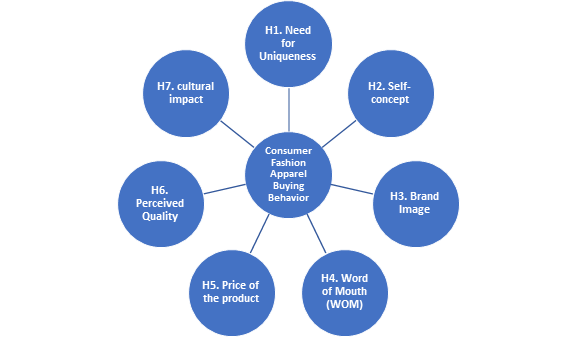
Research question
From the previously mentioned hypothetical and experimental literature, the analyst prepares the main research question:
- What are the factors that influence Dutch consumers’ fashion apparel buying behaviour?
In order to complete this examination, the following sub-research questions were designed.
How does the need for uniqueness and self-concept affect the Dutch consumers’ fashion apparel buying behaviour?
How can brand image influence consumers’ fashion apparel buying behaviour?
How does Word of mouth influence Dutch consumer attitudes and purchase behaviour?
How do Dutch consumers’ get influenced by perceived quality and price of the product?
How does culture influence the fashion apparels buying behaviour of Dutch consumers?
3.Methodology
Research Approach
For The goal of this examination, the researcher will follow deductive approach with quantitative research method. Consequently, this specific research is design as a quantitative research according to analysis and developing survey method. Research problem and therefore the aim of the analysis are mainly the influencing factors to choose this reliable study technique. The collected information for this study is to be appraised with the use of SPSS to accept or reject null hypotheses, which is created by the researcher. By managing these hypotheses testing, the analyst recognizes the role of elements on consumer buying behaviour of fashion apparel in the Netherlands.
Research design
(McGivern,2006) states that, ‘’research design may be a framework on that sensible quality analysis is developed.’’ Hence, the exact research design structure develops an accurate foundation to provide evidence to honestly answer the research problems. In this research, cross-sectional research design will be used because it is the greatest function to answer the survey questions in this examination. A cross-sectional study is “the collecting of information on more than one case and at a particular point in time so as to the collection of quantitative data in relationship with at least two or more factors, which are then examined to recognize examples of association” (Bryman, 2007). There are a few motivations or reasons to select this technique. Above all else, Cross-sectional research design incorporates a higher number of cases, to sum up, and discover differences between variables. Moreover, it uses a positivist approach and completed with quantitative information collecting. Besides that, SPSS will be utilized to examine collected information and hence enables the researcher to compare between variables.
Data Collection:
The goal of this examination, the researcher will use both secondary and primary sources of data information. To collect secondary data from Books, databases and other dependable sources which assists to decide different elements that may have an influence on the consumer buying behaviour of fashion apparel. Surely, dependable literature inspires us to comprehend customers’ purchasing behaviour, fashion apparel and factors influence consumer fashion apparel buying behaviour.
In order to examine the present research issue, the researcher will collect primary data by utilizing the self-administered questionnaire. To collect primary information questionnaires will distribute at the supermarket, universities students and clothing store in the Netherlands.
To collect information, the researcher selects a convenience sampling technique. This technique is chosen as respondents are effortlessly accessible. convenience sampling technique which includes choosing the sample objects from which areas are now accessible to choose or members who are prepared to answer for research problems (joseph F. Hair, J., et al. 2007). This strategy is perfect for unknown people and investigating new research setting (David and Sutton, 2011; Kent, 2007).
Population and Sample size
Polit and Hungler (1999; 37) define “population as a total or totality of the considerable number of objects, subjects or individuals that conforms to an arrangement of particulars”. Notwithstanding, a sample is a subsection of an aggregate or a small amount of the population, chosen by the analyst to take part in the study project (Brink 1996:133; Polit and Hungler 1999:227). Though, sampling size is the procedure to choose a percentage of the population that characterise the total population (LioBiondo-Wood and Haber, 1998; Polit and Hungler, 1999).
The goal of this examination is to discover the factors of fashion apparel influencing customers’ purchasing behaviour. Thus, the researcher chooses a survey as a study strategy, where a consumer analysis will be directed to collect data from buyers who purchase consumer fashion apparel in the Netherlands. A survey achieves demonstrate from a sample of individuals throughout self-report where individuals respond to a sequence of questions presented by the researcher (Polit and Hungler, 1993).
The researcher expects to conduct a survey of 250 individuals in the Netherlands. Thusly, the questions of this analysis are effortlessly accessible. Additionally, this method needs a low cost to tool and as the analyst is a student who has less money, this methodology is the best choice. Moreover, the subjects are comprising of individuals of various ages, sexes, instructive qualifications, work and social status.
Data analysis
Once gathering data, it must be recorded, organized and analysed. On the other hand, information should be refined and relevant. Consequently, the collected information from this analysis is submitted and investigated with the support of SPSS so as to have the capacity to make a correlation between factors. There are many ways and methods available for hypothesis testing.
The researcher will apply inferential statistics and t test to test the hypotheses. t test is chosen as it tests the null hypotheses that is developed from the existing literature. Moreover, the researcher codes the responses which allows to gain inferential statistics.
Data testing
This thesis will be conducted the multicollinearity test, model specification test, normality test for residuals, linearity test, autocorrelation test, unit root test, and heteroskedasticity test.
Measurement
Reliability
Saunders et al., (2009), defines reliability as “the amount of your information collection strategies or analysis method that will produce predictable findings “. There are three noticeable variables incorporated in reliability which are internal validity, stability and interobserver reliability.
The researcher attempts to set up stability throughout measurement procedure by discovering indicators and avoid emotional presence while developing the questionnaire try to ignore the influence of the results by any outside factors. The researcher believes that the measure will not differ after some time by measuring the Cronbach’s alpha before conducting statistical tests. The researcher plans to set a minimum Cronbach’s alpha value i.e. 0.5 with the goal that each summating scale should have satisfactory internal validity which begins from the resulting measurement. However, 0.7 is the minimum level of Cronbach’s alpha for the limited research, on the other hand, the author will accept 0.5 as a basic Cronbach’s alpha value as the surveys are administered so that avoid the researcher’s effect on the outcome.
Additionally, researchers have thought about how completely answered questionnaires will be analysed. Subsequently, researchers can be said that the primary data applied in this analysis is reliable and safe for the next prediction.
Validity
Sekaran and Bougie (2010 pp.157) specify that validity is a test of how well an instrument that is created measures the specific idea it is expected to measure’. Researcher believe that validity of this paper is high because of Researcher is measuring what Researcher are mean to measure. Researcher developed the self-design questionnaire with a minimal risk of misunderstanding. The answers will be collected from online survey, traditional paper and pencil self-administration ‘interview’ methods (PAPI) and all participant are Dutch nationality. When Researcher developed our questionnaire, Researcher had theoretical concepts in mind. It is explained that the questionnaire is for academic research in order to receive more positive results and return rates.
In my report validity is extern because of organize the question, solve the question and finding the result. In addition, the data Researcher will collect through this questionnaire it is can be free from systematic and random error. Thus, it can be said the questionnaire has met all of the requirements of validity.
The questionnaires designed for this research which taken from the conceptual framework which is important to generate a response on consumer fashion apparel buying behaviour. The measurement of independent variables will be applied very first time in this report. All The independent variables are measured from the five-point liker scale measurement. These questionnaires measured under independent variables.
Need for Uniqueness
- My expectation regarding products Uniqueness is high.
- I am looking for unique products.
- I think that the design of the clothing is unique and very appealing to me.
Self-Concept
- I feel self-concept go with my buying behaviour.
- Without a lot of thinking I buy clothing when I find something like self-concept.
Brand Image
- I think brand products are fashionable and elegant.
- I think brand products is well- known and prestigious.
- I think brand has a reputation for high quality.
- I consider loyal towards brand products.
- I think brand Offers products with excellent design.
- Brand Offers very durable products.
Word of Mouth (WOM)
- I take recommendation from my friends and family.
- I have favourable attitudes towards Word of Mouth.
- It is important that others like the product that I buy.
Price of the product
- Offers good quality products with reasonable price.
- price is my first priority among cloths.
- I generally choose brands because of price.
Perceived Quality
- I can understand products quality by seen it.
- It is easy to find products reliability by seen it.
Cultural Impact
- I believe culture plays important role in buying behaviour.
- Do you believe that fashion products are influence by culture?
Research Ethics
Kent (2007, p. 38) states, ” Ethics are moral standards that monitor the techniques by which people treat their fellow individuals in circumstances where they can reason of actual or potential damage, regardless of whether financial, physical and psychological”. The researcher monitors different ethical positions in connection to the confidentiality of the two respondents and the outcomes of the analysis. It is important for this examination to save the respondents data top-secret and not to inform the results to unknown persons and outsider. Other than that, the originality of all contributors will be kept private to avoid any problem to them. The researcher avoids any sort of dishonesty in this examination and clarifies the honest reason for this information gathering method to the respondents.
Reference:
Aaker, D. A. 2009. Managing brand equity. New York: The Free Press.
Arndt, J. (1967). Role of Product-Related Conversations in the Diffusion of a New Product. Journal of Marketing Research,4(3), 291. doi:10.2307/3149462
Brink, H. (1996). Fundamentals of research methodology for health care professionals. Kenwyn.
Bryman, A. a. (2007). Business research methods. Oxford University Press.
Bryman, A. (2008). Social research methods. Oxford: Oxford University Press.
Bryman, A. a. (2011). Business research methods. Oxford University Press.
Bryman, A., & Bell, E. (2011). Business research methods. Oxford: Oxford Univ. Press.
Chen, I. J., Gupta, A., & Rom, W. (1994). A Study of Price and Quality in Service Operations. International Journal of Service Industry Management,5(2), 23-33. doi:10.1108/09564239410057663
Churchill, G. A., & Peter, J. P. (1998). Marketing: Creating value for customers. Boston, MA: Irwin.
Companies and Markets. 2015. Apparel Industry Trends 2015. (n.d.). Retrieved from http://www.free2work.org/trends/apparel2015/Free2Work-Apparel-Industry-Trends-2015.pdf
Czinkota, M. R., & Ronkainen, I. A. (2004). International marketing. Australia: Thomson/South-Western.
David, M. a. (2011). Social research an introduction. CA: SAGE Publications.
Dictionary.com. 2014. Meaning of Unique. (n.d.). Retrieved from http://dictionary.reference.com/browse/ unique?s=t
Gauzente, C., & Roy, Y. (2012). Message content in keyword campaigns, click behavior, and price-consciousness: A study of millennial consumers. Journal of Retailing and Consumer Services,19(1), 78-87. doi:10.1016/j.jretconser.2011.09.003
Hair, J. (2007). Research methods for business. Chichester: Wiley.
Han, H., & Ryu, K. (2009). The Roles of the Physical Environment, Price Perception, and Customer Satisfaction in Determining Customer Loyalty in the Restaurant Industry. Journal of Hospitality & Tourism Research,33(4), 487-510. doi:10.1177/1096348009344212
Hansen, K. (2004). The World in Dress: Anthropological Perspectives on Clothing, Fashion, and Culture. Annual Review of Anthropology,33, 369-392. doi:https://doi.org/10.1146/annurev.anthro.33.070203.143805
Harrison-Walker, L. J. (2001). The Measurement of Word-of-Mouth Communication and an Investigation of Service Quality and Customer Commitment As Potential Antecedents. Journal of Service Research,4(1), 60-75. doi:10.1177/109467050141006
Hung, K. H., & Li, S. Y. (2007). The Influence of eWOM on Virtual Consumer Communities: Social Capital, Consumer Learning, and Behavioral Outcomes. Journal of Advertising Research,47(4), 485-495. doi:10.2501/s002184990707050x
Jayasingh, S., & Eze, U. C. (2012). Analyzing the Intention to Use Mobile Coupon and the Moderating Effects of Price Consciousness and Gender. International Journal of E-Business Research,8(1), 54-75. doi:10.4018/jebr.2012010104
Kawabata, H., & Rabolt, N. J. (1999). Comparison of clothing purchase behaviour between US and Japanese female university students. Journal of Consumer Studies and Home Economics,23(4), 213-223. doi:10.1046/j.1365-2737.1999.00112.x
Keller, K. L. (1993). Conceptualizing, Measuring, and Managing Customer-Based Brand Equity. Journal of Marketing,57(1), 1. doi:10.2307/1252054
Kent, R. (2007). Marketing research: Approaches, methods and applications in Europe. Thomson learning.
Klepp, I. G., & Storm-Mathisen, A. (2005). Reading Fashion as Age: Teenage Girls and Grown Womens Accounts of Clothing as Body and Social Status. Fashion Theory,9(3), 323-342. doi:10.2752/136270405778051329
Koh, T., & Fang, W. (2012). The effects of corporate social responsibility on purchase intention: The mediating effects of brand attachment and brand image. Journal of Business Administration,94, 41-68.
Kotler, P., & Keller, K. L. (2006). Marketing management. Upper Saddle River: Prentice Hall.
Kotler, P., Bowen, J., & Makens, J. C. (2010). Marketing for hospitality and tourism. Boston: Pearson.
Kotler, P., & Armstrong, G. (2014). Principles of marketing. Boston, MA: Pearson.
Kumar, A., Kim, Y., & Pelton, L. (2009). Indian consumers purchase behavior toward US versus local brands. International Journal of Retail & Distribution Management,37(6), 510-526. doi:10.1108/09590550910956241
Kumar, P. (2010). Marketing of Hospitality & Tourism Services. McGraw-Hill Education.
Kukar-Kinney, M., Xia, L., & Monroe, K. B. (2007). Consumers’ perceptions of the fairness of price-matching refund policies. Journal of Retailing,83(3), 325-337. doi:10.1016/j.jretai.2007.03.005
Lee, M., & Burns, L. D. (1993). Self Consciousness and Clothing Purchase Criteria of Korean and United States College Women. Clothing and Textiles Research Journal,11(4), 32-40. doi:10.1177/0887302×9301100405
Lee, J. A., & Kacen, J. J. (2008). Cultural influences on consumer satisfaction with impulse and planned purchase decisions. Journal of Business Research,61(3), 265-272. doi:10.1016/j.jbusres.2007.06.006
Lichtenstein, D. R., Ridgway, N. M., & Netemeyer, R. G. (1993). Price Perceptions and Consumer Shopping Behavior: A Field Study. Journal of Marketing Research,30(2), 234. doi:10.2307/3172830
LoBiondo-Wood, G. a. (1998). Nursing research: Methods and critical appraisal for evidence-based practice. Elsevier Health Sciences.
Lynn, M., & Harris, J. (1997). The desire for unique consumer products: A new individual differences scale. Psychology and Marketing,14(6), 601-616. doi:10.1002/(sici)1520-6793(199709)14:63.3.co;2-f
Martin, O., & Jacob, F. (2010). Empowered involvement and word of mouth: Conceptual model and first empirical evidence. Journal of Marketing Trends,1, 25-33.
Matthiesen, I., & Phau, I. (2010). Brand image inconsistencies of luxury fashion brands. Journal of Fashion Marketing and Management: An International Journal,14(2), 202-218. doi:10.1108/13612021011046066
Oconnor, K. (2005). 3 The Other Half: The Material Culture of New Fibres. Clothing as Material Culture,41-60. doi:10.2752/9780857854056/clmatcult0006
Palazón, M., & Delgado, E. (2009). The moderating role of price consciousness on the effectiveness of price discounts and premium promotions. Journal of Product & Brand Management,18(4), 306-312. doi:10.1108/10610420910972837
Pereira, M., Azeved, S., Ferreira, J., Migul, R., & Pedroso, V. (2010). The influence of personal factors on consumer buying behaviour in fashion. International Journal of Management Cases,12(2), 509-518.
Phau, I., & Lau, K. C. (2001). Brand personality and consumer self-expression: Single or dual carriageway? Journal of Brand Management,8(6), 428-444. doi:10.1057/palgrave.bm.2540042
Polit, D. F., & Hungler, B. P. (1993). Nursing research: Principles and methods (3rd edition). Philladelphia: Lippincott.
Polit, D. F., & Hungler, B. P. (1999). Nursing Research: Principles and Methods. Philadelphia: J.B. Lippincott.
Rajagopal. (2006). Brand excellence: Measuring the impact of advertising and brand personality on buying decisions. Measuring Business Excellence,10(3), 56-65. doi:10.1108/13683040610685793
Ryu, K., & Han, H. (2009). Influence of the Quality of Food, Service, and Physical Environment on Customer Satisfaction and Behavioral Intention in Quick-Casual Restaurants: Moderating Role of Perceived Price. Journal of Hospitality & Tourism Research,34(3), 310-329. doi:10.1177/1096348009350624
Saunders, M., & Lewis. P. and Thornhill, A. (2009). Research methods for business students. Prentice hall, Financial Times.
Schiffman, L. G., Hansen, H., & Kanuk, L. L. (2011). Consumer behaviour: A European outlook. Harlow: Financial Times Prentice Hall.
Schindler, R. M., & Bickart, B. (2012). Perceived helpfulness of online consumer reviews: The role of message content and style. Journal of Consumer Behaviour,11(3), 234-243. doi:10.1002/cb.1372
Tian, K. T., Bearden, W. O., & Hunter, G. L. (2001). Consumers Need for Uniqueness: Scale Development and Validation. Journal of Consumer Research,28(1), 50-66. doi:10.1086/321947
Tian, K. T., & Mckenzie, K. (2001). The Long-Term Predictive Validity of the Consumers’ Need for Uniqueness Scale. Journal of Consumer Psychology,10(3), 171-193. doi:10.1207/s15327663jcp1003_5
Trusov, M., Bucklin, R. E., & Pauwels, K. (2009). Effects of Word-of-Mouth versus Traditional Marketing: Findings from an Internet Social Networking Site. Journal of Marketing,73(5), 90-102. doi:10.1509/jmkg.73.5.90
Tsiotsou, R. (2006). The role of perceived product quality and overall satisfaction on purchase intentions. International Journal of Consumer Studies,30(2), 207-217. doi:10.1111/j.1470-6431.2005.00477.x
Vikkraman, P., & Sumathi, N. (2012). Purchase Behaviour in Indian Apparel Market: An Analysis. ZENITH International Journal of Business Economics and Management Research,2(2), 1-12.
Watchravesringkan, K. (., Yan, R., & Yurchisin, J. (2008). Cross‐cultural invariance of consumers price perception measures. International Journal of Retail & Distribution Management,36(10), 759-779. doi:10.1108/09590550810900982
Workman, J. E., & Kidd, L. K. (2000). Use of the Need for Uniqueness Scale to Characterize Fashion Consumer Groups. Clothing and Textiles Research Journal,18(4), 227-236. doi:10.1177/0887302×0001800402
Zeb, H., Rashid, K., & Javeed, M. (2011). Influence of Brands on Female Consumers Buying Behavior in Pakistan. International Journal of Trade, Economics and Finance,225-231. doi:10.7763/ijtef.2011.v2.107
Zeithaml, V. A. (1988). Consumer Perceptions of Price, Quality, and Value: A Means-End Model and Synthesis of Evidence. Journal of Marketing,52(3), 2. doi:10.2307/1251446
Appendices
Appendix A1: Questionnaire
Questionnaire for Consumer buying behavior
Following Questionnaire will be used to collect data as part of my master’s thesis which is titled ‘Influence on consumer behavior in the fashion industry.’ Data collected here will only be analyzed in general. All responses will be kept highly confidential and used for academic purpose only.
Section I: General Information. Please tick in front of the correct answer or and in other cases
Write Short answers.
Please state your gender
- Male
- Female
- Please state your age group
- 18-24
- 25-34
- 35-44
- 45-54
- 55-64
- 65+
- Please state your current employment status
- Student
- Unemployed
- Self-employed
- Part time employment
- Full time employment
- Retired
- On average how much would you spend on fashion apparel?
- €50-€99
- €100-€149
- €150-€199
- €200-€249
- €250+
for following statements. For Each Statement You have 5 choices ranging from Strongly Disagree to Strongly Agree. Following are the Values assigned for each choice.
| Strongly Disagree = 1 | Agree = 4 |
| Disagree = 2 | Strongly Agree = 5 |
| Neither Agree nor Disagree = 3 |
Following Questionnaire are draft questions. It is not final survey question. Researcher collected these questions from different sources.
My expectation regarding products Uniqueness is high
1 2 3 4 5
I am looking for unique products
1 2 3 4 5
I think that the design of the clothing is unique and very appealing to me.
1 2 3 4 5
I feel self-concept go with my buying behavior.
1 2 3 4 5
Without a lot of thinking I buy clothing when I find something like self-concept.
1 2 3 4 5
I think brand products are fashionable and elegant
1 2 3 4 5
I think brand products is well- known and prestigious.
1 2 3 4 5
I think brand has a reputation for high quality.
1 2 3 4 5
I consider loyal towards brand products.
1 2 3 4 5
I think brand Offers products with excellent design.
1 2 3 4 5
Brand Offers very durable products.
1 2 3 4 5
I take recommendation from my friends and family
1 2 3 4 5
I have favorable attitudes towards Word of Mouth.
1 2 3 4 5
It is important that others like the product that I buy.
1 2 3 4 5
Offers good quality products with reasonable price.
1 2 3 4 5
price is my first priority among cloths.
1 2 3 4 5
I generally choose brands because of price.
1 2 3 4 5
I can understand products quality by seen it.
1 2 3 4 5
It is easy to find products reliability by seen it.
1 2 3 4 5
I believe culture plays important role in buying behavior.
1 2 3 4 5
Do you believe that fashion products are influence by culture?
1 2 3 4 5
 Market Research