Atikur Bhuiyan
1. Introduction:
The dramatic development of information technology such as internet and web based platform, and the external trend including globalisation, increased competition, changing pattern in consumer behaviour have changed the innovation process which was traditionally executed inside the organisation (Dvorak, 2013). In this dynamic environment, the competitive strength of organisations is mostly determined and shaped by its general design and innovation capabilities and successful utilization of such capabilities. The readiness and responsiveness of design and innovation is commercially critical to the growth of success of organisations (Okpara, 2007).
Galaxy is the most revolutionary invention of Samsung Electronics in Smartphone Industry. The journey of Galaxy series started in April 2009 with its i7500 model as breakthrough innovation. The success of this model inspired Samsung to go beyond and to focus on incremental innovation of Galaxy series thereby the company introduced Galaxy S in the following year, S2 in 2011, S3 in 2012, S4 in 2013, and S5 in 2014. The real impact was made by S3 in the Smartphone industry. The overwhelming buzz Samsung has created with its latest S5 proves that the Galaxy family is still to dominate the Smartphone industry. Samsung launched S5 in February 2014. S5 was introduced with an enlarge screen 5.1-inch Super AMOLED option and 16 Mega Pixel camera and a 2800mAh rocking up battery (Neild, 2014). The introduction of Samsung Galaxy S5 was one of the most anticipated phones for the year 2014 (Samsung, 2014).
The objectives of this report is to critically demonstrate the innovative characteristics of Samsung Galaxy Phones, Specifically Galaxy S5 and how Samsung has changed innovative characteristics and innovation approach over time since 2009, first inception of Galaxy series, to suit the changing needs of the market. This report will be conducted through taking the following areas into the accounts:
- The benefits and value derived by the customers
- The uniqueness of design elements including shape, colour, design, imagination, relevance and usefulness
- The brand appeal of Samsung in relation to competitors in contemporary market.
2. Benefits and value derived from Galaxy 5 by customers:
Customers derive value from both product attributes and the attribute performance and consequences of attaining desired goals from the use of the products (Woodruff, 1997). This statement is supported by the revolutionary motivation theory, Maslow’s Hierarchy of Needs Theory, developed by Maslow (1943) where he divided human needs into five categories: physiological needs, safety needs, belongingness needs, esteem needs, and self-actualization needs (Appendix 2). Based on the features of Samsung Galaxy S5 features and benefits, it can be said that it meet the basic needs trough offering mobile telecommunication facilities; safety needs can be filled health support, weather, as well as calendar information; social and love need can be filled through enabling users to contact with their loved ones though using mobile communication, social network, and so on; while esteem needs are filled as S5 symbolize high-class capable and luxury. Samsung Galaxy S5 delivered all these needs through three key segments recommended by Ben Thomson in his Mobile Hierarchy of Needs: Hardware, software, and apps (Thompson, 2013). The innovation of Samsung Galaxy phones including S5 outlined in the appendix 1 have good enough hardware, good enough software, and good enough selection of applications (Thompson, 2013).
In addition to delivering the best combination in term of increase variety and increase quality of functions (appendix 1) including camera, internet, email, mp3, user connectivity, games, video recording, and so on; Samsung innovates on the usability trajectory, the easiness of managing the devices and all the choice of service provided by it, in its Galaxy S5 that according the Christensen (1997) met the latent needs of customers creating new market for Smartphone. Nevertheless, the most significant value offered by a Smartphone is being a great mobile communicator and the compatibility of services is the key feature of what can make a Smartphone a great communication tool (Ritchie et al. 2014). The great text input, super notification, and compatibility with whatever communication services users’ friend, family and colleague use make it a great mobile communicator with compatible features.
Customer centric open innovation to fit with changing customer demand:
The dramatic development of information technology such as internet and web based platform, and the external trend including globalisation, increased competition, changing pattern in consumer behaviour have changed the innovation process which was traditionally executed inside the organisation. The concept of customer centric and open innovation approach or co-innovation entailing the knowledge, creativity and judgement of customers to generate value is considered to be an upcoming trend for organisations (Dvorak, 2013). Open innovation is described broadly by William (2003) as a paradigm which assumes that organisations should use external ideas and internal and external paths to market in order to advance their technology.
In order to ensure that the innovation of Samsung suits with the changing needs of the market, the company adopted customer centric and open innovation strategy that aims to trap into customer insights to drive growth, thus the company constantly seeks to look at their customer insights. A customer centric and open innovation approach with structured innovation management is applied by the company as they brought in external ideas from customers, other sources and organisations for adding to their own internal ideas (Olson, 2013).
Since the needs of customers and the marketing environment have been changing overtime (Dvorak, 2013), Samsung consistently tired to offer improved in the functionality and usability of Galaxy Family over the times since 2009. All the models of Galaxy Phones have seen advanced camera, improved network connectivity, improved processor, improved battery life and so on. The latest Galaxy S5 combines advanced camera with world’s fastest auto focus, superior network connectivity, improved device protection feature IP67 dust and water resistance and dedicated fitness tools with s Health 3.0.
3. Shape, colour, design, imagination, relevance and usefulness:
Samsung constantly strive to attain leadership is delivering the best and most innovative imaging products in the market. Colour, design and shape have always got impressive attention in Samsung (Samsung, 2014). In the Smartphone industry, the real impact was made by Samsung in May 2012 when it brought its flagship phone in the shape of the Galaxy S3 after a brief Google-sponsored detour to make the Galaxy Nexus. Samsung Galaxy S3 was in fact considered the best Smartphone till then. With bigger screen and enlarge AMOLED display to 4.8 inches with a resolution of 720 x 1280 pixels, and super design, design, display, battery life, and responsiveness made this product sense of pleasure to the customers (Neild, 2014).
S5 was introduced with an enlarge screen 5.1-inch Super AMOLED option and 16 Mega Pixel camera and a 2800mAh rocking up battery. The latest Galaxy phone, S5 is available in black, copper gold, electric blue and shimmery white (Samsung, 2014). The overwhelming buzz Samsung has created with its latest S5 proves that the Galaxy family is still to dominate the Smartphone industry. Samsung launched S5 in February 2014. S5 is 8.1mm thick, soft plastic, water-resistant; while its key competitor product, iPhone 6, is 6.9mm thick, anodised aluminium back (appendix 3) (Kypreos, 2014).
In order to match with the changing needs of customers and to beat the competitors, Samsung has constantly changed its Galaxy Phones since 2009. It has introduced a latest version every year with improved design, features, colour, functions, imagination as well as shape. For example, the Galaxy i7500 has 3.2-inches screen, while Galaxy S had 4-inch. At the same way, S2, S3, S4, and S5 have introduced enlarged screen 4.3-inch, 4.8-inch, 5-inch, and 5.1 inch. Like the screen, the battery life of these models was improved from 1500mAh in Galaxy i7500 to 2800mAh in S5.
Table 1: An overview of S5 design
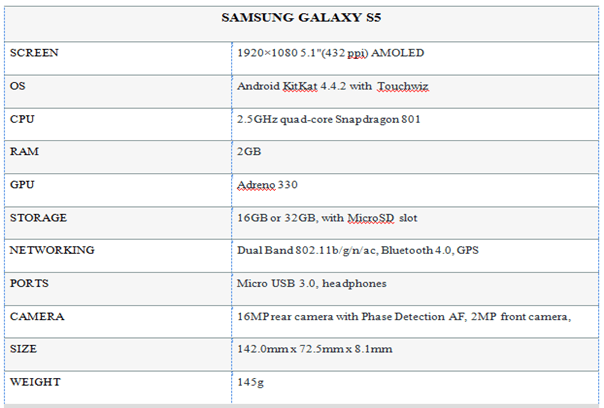
Appendix 1 addressed how Samsung has changed the design, colour, shape and imagination of its Galaxy Phone since 2009.
Beside the physical layout the uniqueness of Samsung from its main competitors can be evident from the features of long lasted battery life, wireless charging facilities, stronger front camera, the size of RAM and the Samsung product is designed in flexible storage system which allow the user to install extra or additional SD card which is not match with the product features of iPhone. In addition to the above the longer battery life and keeping free from ‘call failure’ that still push the Apple Brand into a deep trouble and they are still surviving to resolve this problem.
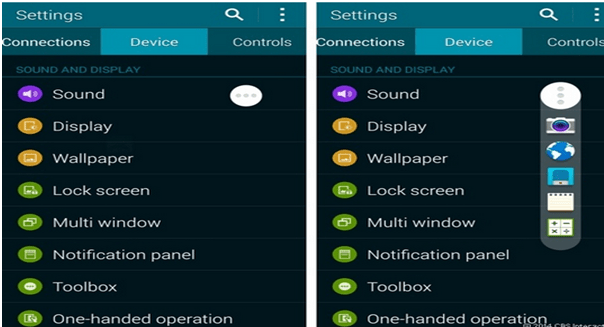
The uniqueness of Samsung Galaxy phones can be mentioned the wider screen, long lasted battery life, heavy resolution for front and back camera, heavy storage size, wireless charging facilities, water resistance, ultra power saving mode, and download booster. However, it has failed to create uniqueness in scanner, plastic case, heart rate monitor, and bloatware. In addition to this software lacking, Samsung recognised its menu button (figure 1) to be re-implemented (Larsen, 2014).
Figure 1: Menu button of Galaxy S5
4. Brand appeal in relation to competitors in contemporary markets
Brand value refers the worth of a brand to management and shareholders. It can be conceived as the sale or replacement value of a brand (Tiwari, 2010). Interbrand is the most widely recognised body for the valuation of brands. According to its latest report on global top hundred brands, the brand value of Samsung has increased by 15% in 2014 to reach total brand value of US $45.462 billion. It further helped the company to be the top seventh global brand from eighth position in the last year. However, the foremost rival of Samsung in the Smartphone industry, Apple, retain the top position with an increase of 21% to reach total brand value of US $118.863 (Interbrand, 2014).
Figure 2: Top ten brand in 2013-2014

Brand positioning is the act of designing the image and offer in accordance with placing distinct value in the minds of target customers (Kotler, 2000). Differentiation is the key contemporary strategy organisations use to create strong brand positioning (Janiszewska and Insch, 2012), specifically Smartphone industry (Hill and Jones, 2013). Differentiation is further one of the key strategies, suggested by Porter (2004), companies in Smartphone industry frequently used to attain competitive advantage. Though Samsung used the cost leadership strategy to attain competitive advantage over rivals, the differentiation is the key strategy the company used for its Galaxy phones (figure 3).
Figure 3: Competitive strategy for brand positioning, Galaxy S5
Created by the Author (2014, based on Porter, 2004)
In order to find a proper location in customers’ minds so that they can think about Galaxy S5, Samsung focuses on offering distinct value to the customers through investing in hardware and software. Considering the heavy competition in the market, Samsung constantly investing in software and hardware features into the Galaxy phones to make the real differentiation. The points of differentiation in Galaxy phones are more features and better features for the money customers pay for it. In spite of its advancement in cost leadership, and advanced features from the perspective of hardware and software, Samsung is yet to close with its foremost competitor, Apple: the degree to which Apple can dictate and exercise control (Golvin, 2014).
Samsung constantly strive to attain leadership is delivering the best and most innovative imaging products in the market (Samsung, 2014). However, Apple is the most profitable Smartphone marketer with numbers of competitive advantages. Momentum, design powers, complete control over its end-to-user experiences, and number of key new revenue channels. However, there is a key area, cost, where Samsung outplayed Apple and other stamrtphone marketers. The key advantage of Samsung is cost advantage.
The Galaxy phones, specifically S2 and S3 helped Samsung to be the market leader in the global Smartphone industry over its rivals, Apple and others. However, in recent years it slightly lost its momentum due to cheap Chinese Smartphone. The following figure 4 shows how other small companies are increasing their market share in the industry.

5. Conclusion:
The competitive strength of organisations nowadays is mostly determined and shaped by its general design and innovation capabilities and successful utilization of such capabilities. The readiness and responsiveness of design and innovation is commercially critical to the growth of success of organisations. Galaxy is the most revolutionary invention of Samsung Electronics in Smartphone Industry. The journey of Galaxy series started in April 2009 with its i7500 model as breakthrough innovation. The success of this model inspired Samsung to go beyond and to focus on incremental innovation of Galaxy series thereby the company introduced numbers of models in the following years. The real impact was made by S3 in the Smartphone industry. The overwhelming buzz Samsung has created with its latest S5 in 2014 proves that the Galaxy family is still to dominate the Smartphone industry.
Samsung consistently tired to offer improved in the functionality and usability of Galaxy Family over the times since 2009. All the models of Galaxy Phones have seen advanced camera, improved network connectivity, improved processor, improved battery life and so on. The uniqueness of Samsung Galaxy phones can be mentioned the wider screen, long lasted battery life, heavy resolution for front and back camera, heavy storage size, wireless charging facilities, water resistance, ultra power saving mode, and download booster.
Considering the heavy competition in the market, Samsung constantly investing in software and hardware features into the Galaxy phones to make the real differentiation. The points of differentiation in Galaxy phones to create strong brand positioning are more features and better features for the money customers pay for it. In spite of its advancement in cost leadership, and advanced features from the perspective of hardware and software, Samsung is yet to close with its foremost competitor, Apple: the degree to which Apple can dictate and exercise control.
References:
Amadeo, R., 2014. Samsung’s Galaxy S5 has plenty of upgrades—so why does it feel so meh? [Online] Available at http://arstechnica.com/gadgets/2014/04/samsungs-galaxy-s5-has-plenty-of-upgrades-so-why-does-it-feel-so-meh/ (Accessed at 25th December 2014)
Christensen, C., 1997. The Innovator’s Dilemma, Boston: Harvard Business School Press
Dvorak, T., 2013. Co-Innovation: Customer Motives for Participation in Co-Creation Processes via Social Media Platforms, The Netherlands: University of Twente
Golvin, C., 2014. Galaxy S4 Launch Reveals Samsung’s New Market Position, [Online] Available at http://www.forbes.com/sites/forrester/2013/03/15/galaxy-s4-launch-reveals-samsungs-new-market-position/ (Accessed at 26th December 2014)
Hill, C. and Jones, G., 2013. Strategic Management: An Integrated Approach, Mason: South-Western Cengage Learning
Interbrand (2014) Interbrand’s 15th annual Best Global Brands Report, [Online] Available at http://interbrand.com/en/newsroom/15/interbrands-th-annual-best-global-brands-report (Accessed at 19 December 2014)
Janiszewska, K. and Insch, A., 2012. The strategic importance of brand positioning in the place brand concept: elements, structure and application capabilities, Journal of International Studies, Vol. 5, No 1, 2012, pp. 9-19.
Kotler, P., 2000. Marketing Management: Analysis, Planning, Implementation and Control, 10th Edition, New Jersey: Prentice –Hall
Kypreos, E., 2014. iPhone 6 vs Galaxy S5: Which to buy? [Online] Available at http://www.trustedreviews.com/opinions/iphone-6-vs-galaxy-s5#m8HGI81hvLX4OUUL.99 (Accessed at 19th December 2014)
Larsen, L., 2014. The 5 Best and Worst Features of the Samsung Galaxy S5, [Online] Available at http://www.pastemagazine.com/blogs/lists/2014/04/the-5-best-and-worst-features-of-the-samsung-galaxy-s5.html (Accessed at 18 December 2015)
Nield, D., 2014. The Samsung Galaxy: a history of the S series, [Online] Available at http://www.techradar.com/news/phone-and-communications/mobile-phones/the-samsung-galaxy-a-history-of-the-s-series-1227906 (Accessed at 22 December 2014)
Okpara, F. O., 2007. The value of creativity and innovation in entrepreneurship, Journal of Asia Entrepreneurship and Sustainability, Vol. 3, No. 2, pp. 1-14
Olson, P., 2013. Samsung Opens New Startup Accelerator In Silicon Valley As It Seeks Innovation Edge, Forbes Magazine, [Online] Available at http://www.forbes.com/sites/parmyolson/2013/07/11/samsung-opens-new-startup-accelerator-in-silicon-valley-as-it-seeks-innovation-edge/ (Accessed at 19th December 2014)
Porter, M., 2004. Michael Porter Competitive Advantage, London: Free Press
Ritchie, R., Rubino, D., Michaluk, K. and Nickinson, P. (2014) What you need from a Smartphone, what you want, and how to get it, [Online] Available at http://crackberry.com/talk-mobile/what-you-need-from-smartphone-what-you-want-and-how-to-get-it-talk-mobile (Accessed at 26 December 2014)
Samsung, 2014. Samsung Brings Galaxy S5 and New Gear Devices to Global Market, [Online] Available at http://www.samsung.com/uk/news/local/samsung-brings-galaxy-s5-and-new-gear-devices-to-global-market (Accessed at 18 December 2014)
Statista, 2015. Global market share held by leading smartphone vendors from 4th quarter 2009 to 3rd quarter 2014, [Online] Available at http://www.statista.com/statistics/271496/global-market-share-held-by-smartphone-vendors-since-4th-quarter-2009/ (Accessed at 25th December 2014)
Thompson, B., 2013. Mobile Hierarchy of Needs, [Online] Available at http://stratechery.com/2013/mobiles-hierarchy-of-needs/ (Accessed at 25th December 2014)
Tiwari, M. K., 2010. Separation of Brand Equity and Brand Value, Global Business Review, Vol. 11, No. 3, pp. 421-434
William, C. H., 2003. Open Innovation: The New Imperative for Creating And Profiting from Technology, Boston: Harvard Business School Press
Appendix
Appendix 1: Continuous improvement of Galaxy phone
| Series | Year | Product description |
| Galaxy i7500 | April 2009 | Screen: 3.2-inch OLED, 320 x 480 pixels Battery: 1500mAh CPU: 528MHz, 128MB RAM Key features: One of the early phones to run Android Internal storage: 8GB OS: Android 1.5 |
| Galaxy S | June 2010 | Screen: 4-inch Super AMOLED, 480 x 800 pixels Battery: 1500mAh CPU: 1GHz Cortex-A8, 512MB RAM Key features: Stronger TouchWiz overlay, front-facing camera Internal storage: 8GB / 16GB OS: Android 2.1 |
| Galaxy S2 | April 2011 | Screen: 4.3-inch Super AMOLED Plus, 480 x 800 pixels Battery: 1650mAh CPU: dual-core 1.2GHz Cortex-A9, 1GB RAM Key features: Blazing fast internals, strong camera, brilliant screen Internal storage: 16GB / 32GB OS: Android 2.3.4 |
| Galaxy S3 | May 2012 | Screen 4.8-inch Super AMOLED, 720 x 1280 pixels Battery 2100mAh CPU quad-core 1.4GHz Cortex-A9, 1GB RAM Key features Smart Stay, Android Beam, Pop up Play – all about the software and screen Internal storage 16GB / 32GB / 64GB OS Android 4.0.4 |
| S4 | April 2013 | Screen 5-inch Super AMOLED HD, 1080 x 1920 pixels Battery 2600mAh CPU quad-core 1.6GHz Cortex-A15, 2GB RAM Key features Air gestures, Smart Scroll, Smart Pause, Drama Shot, Infra red remote, humidity sensor Internal storage 16GB / 32GB / 64GB OS Android 4.2.2 Price at launch: £600 |
| S5 | February 2014 | Screen 5.1-inch Super AMOLED HD, 1080 x 1920 pixels Battery 2800mAh CPU Quad-core 2.5GHz Snapdragon 801, 2GB RAM Key features Waterproof, Super fast autofocus, heart rate monitor, fingerprint scanner Internal storage 16GB / 32GB / 64GB OS Android 4.4.2 |
Appendix 2: Maslow’s Hierarchy of Needs Theory
Appendix 3: Design, Shape, Colour and Resolution of Samsung Galaxy S5
The Galaxy S5 is actually a little bigger than the S4. It’s 5.4mm taller, 2.7mm wider, and 0.2mm thicker. Samsung used this extra space to bump the display up to a 5.1-inch, 1080p AMOLED, slightly larger than the 4.99-inch display in the S4. The screen size increase didn’t keep pace with the bigger body though. In a world where bezels are constantly shrinking and OEMs like LG are touting the screen-to-bezel ratio on their devices, Samsung took a step backward. The company made the side bezels thicker and the top and bottom of the device taller. If the image above wasn’t labeled, you would think the S4 (the one on the right) was the newer device.
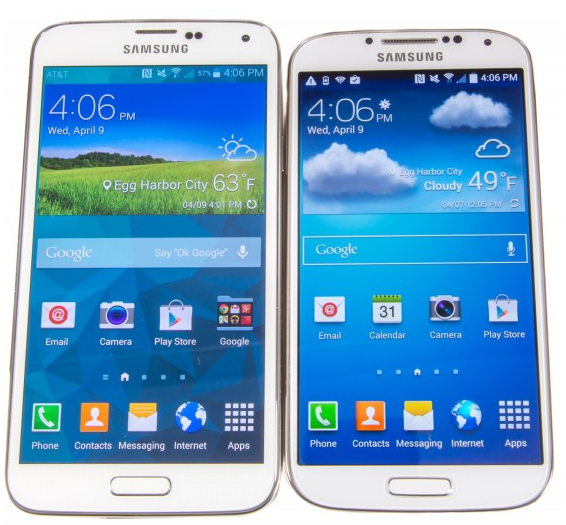
Other than the bloated bezels, the design is very similar to the Galaxy S4. The corners are a little less round, so along with the bigger size, the device creeps slightly closer in appearance to the Note 3. The fronts of Samsung’s entire product line seem to vary only in screen size and corner roundness. Though it’s worth noting the button layout has changed—Samsung finally killed the menu button and now uses the trio of “Recent,” “Home,” and “Back,” with home being a physical button and the other two being capacitive. Being able to quickly hit Recent Apps is a big improvement over the increasingly useless dedicated menu button, which was deprecated in stock Android all the way back in version 3.0. The only downside is that the button layout is backward when compared to everything else—usually the positions of “Recent” and “Back” are swapped.
Source: Amadeo (2014)
 Market Research